What if the most effective way to restore our…
The 3-Step Biological Acceleration Mechanism Transforming Water & Wastewater Treatment
In municipal wastewater treatment, industrial water management, and biological remediation, efficiency hinges on a single question: How quickly and completely can indigenous microbes process organic waste?
Traditional aeration and biological treatment methods often hit a wall due to insoluble organic structures, poor gas transfer rates, and high activation energy requirements. Bio-Organic Catalyst (BOC) technology overcomes these limitations through a synergistic three-step mechanism: Solubilization, Oxygenation, and Catalysis.
Here is how this non-linear bio-catalytic process accelerates system biology and transforms treatment performance.
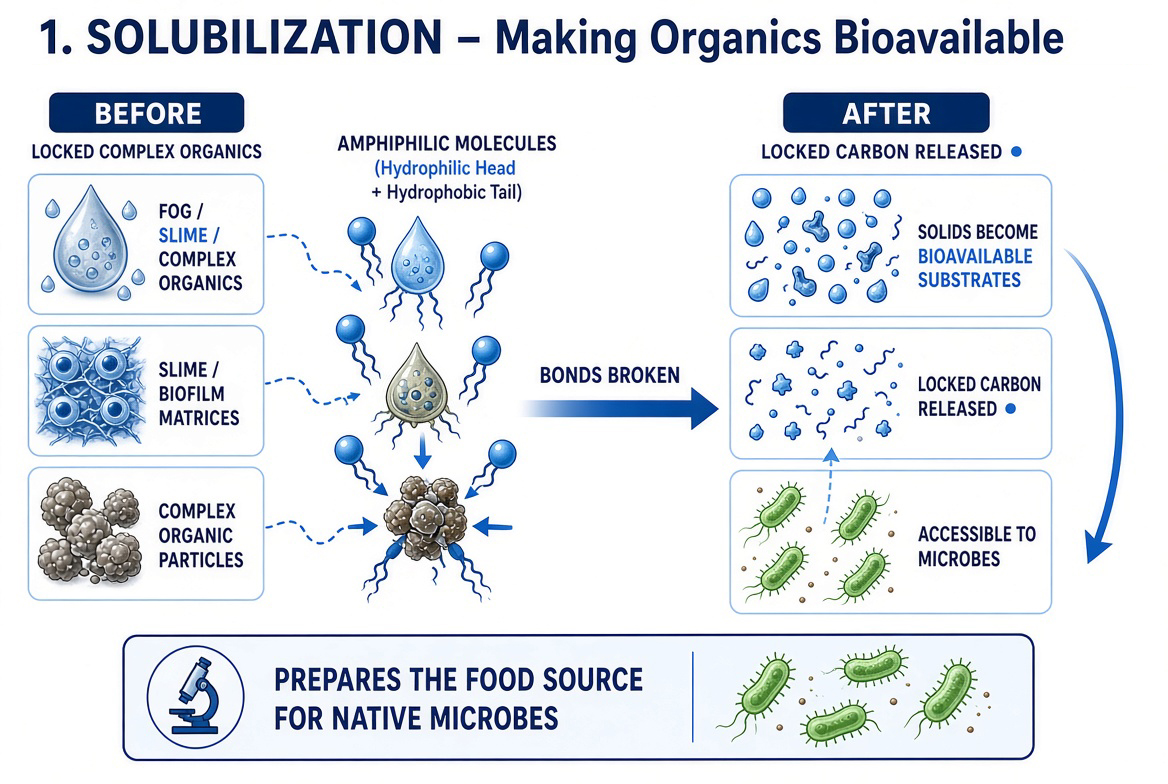
- Solubilization: Making Complex Organics Bioavailable
Before indigenous microbes can consume organic contaminants, those contaminants must be in a form the microbes can actually process. Complex organic waste—such as Fats, Oils, and Grease (FOG), slime/biofilm matrices, and particulate organic matter—is typically locked up in insoluble structures.
- The Mechanism: Amphiphilic molecules featuring hydrophilic (water-attracting) heads and hydrophobic (water-repelling) tails attach to locked organic particles.
- The Result: Molecular bonds break down, converting stubborn solids, FOG, and biofilms into highly bioavailable, solubilized substrates.
- The Impact: Locked carbon is released into accessible food sources, preparing the wastewater matrix for rapid microbial digestion.
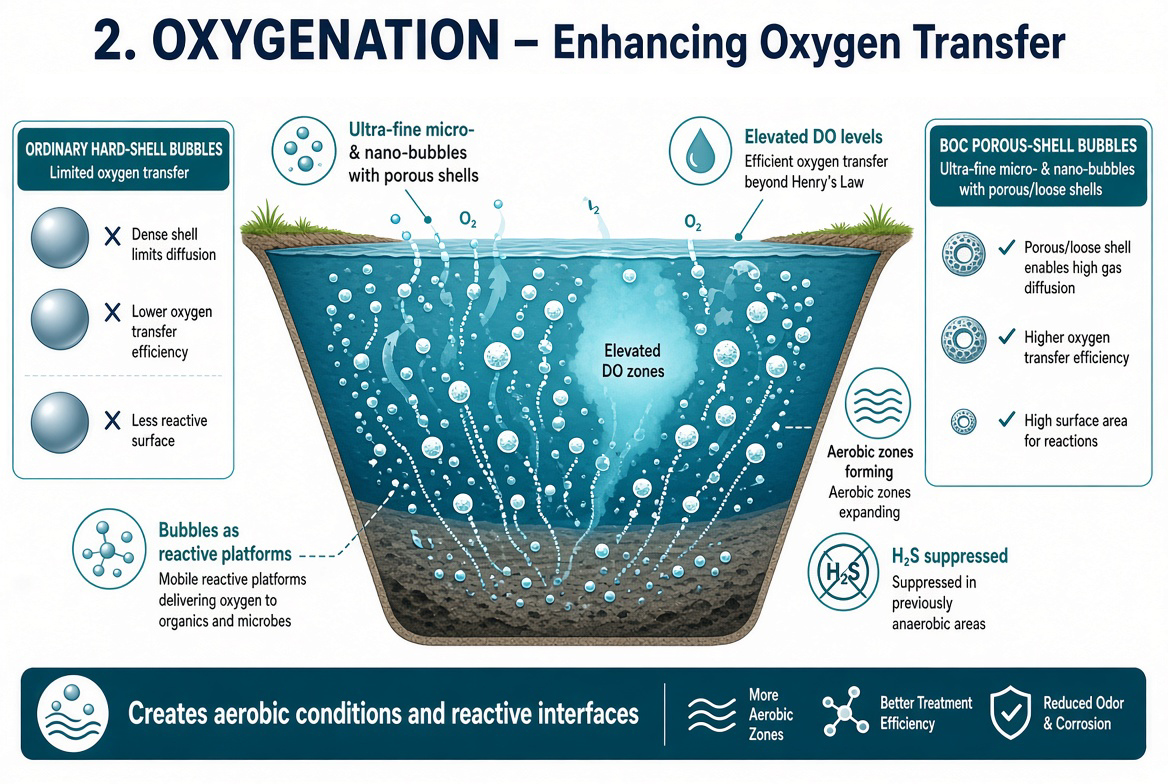
- Oxygenation: Enhancing Micro-Bubble Gas Transfer Efficiency
Biological wastewater treatment relies heavily on dissolved oxygen (DO) to maintain aerobic conditions. Traditional fine-bubble aerators often produce “hard-shell” bubbles with dense gas-liquid interfaces that limit gas diffusion and waste operational energy.
- Porous-Shell Bubble Formation: BOC creates ultra-fine micro- and nano-bubbles featuring porous, loose shells rather than rigid surfaces.
- Superior Mass Transfer: These porous shells dramatically increase diffusion rates and surface area for chemical and biological reactions, driving elevated DO levels beyond traditional Henry’s Law transfer constraints.
- Aerobic Zone Expansion: By transforming bubbles into mobile reactive platforms, aerobic zones expand deep into previously anaerobic areas.
- Odor & Corrosion Control: Expanding aerobic zones suppresses hydrogen sulfide () production, tackling odor problems and infrastructure corrosion at the source.
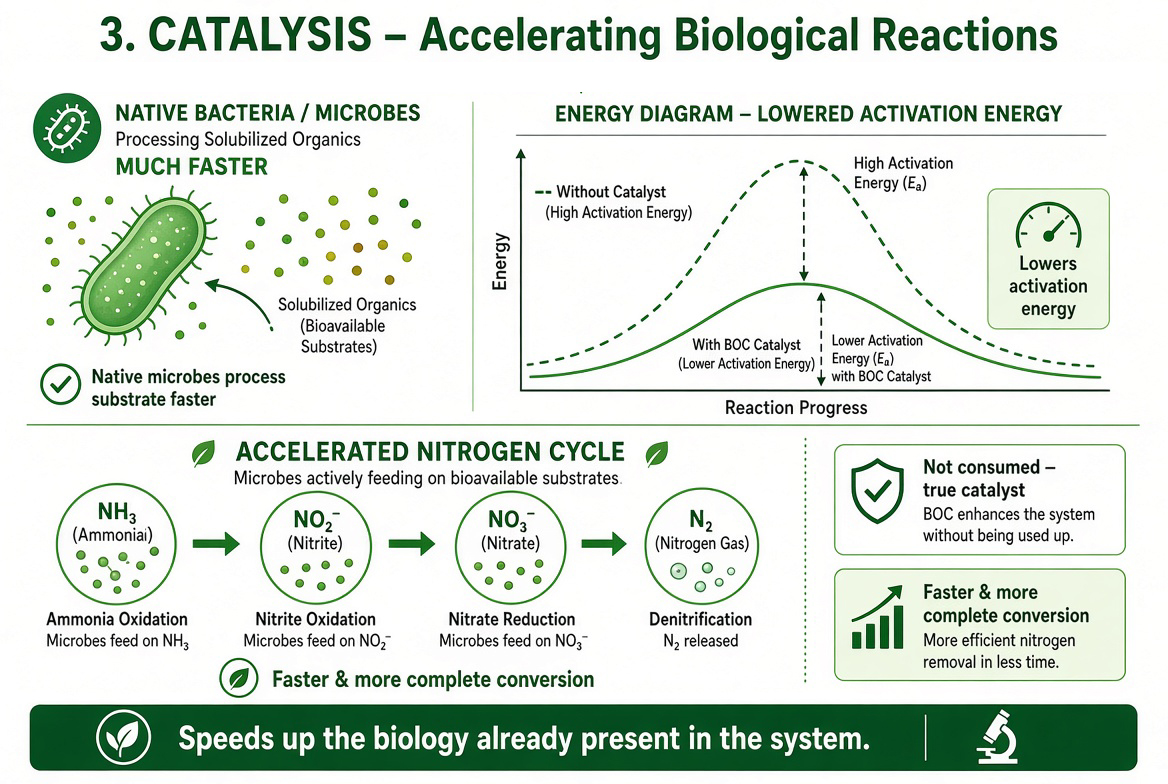
- Catalysis: Accelerating Biological Rates & The Nitrogen Cycle
Once organic matter is bioavailable and dissolved oxygen is maximized, the final step is accelerating the biological digestion rate without adding foreign bacteria to the ecosystem.
- Lowering Activation Energy (): As true catalysts, BOC molecules lower the activation energy required for biochemical reactions to occur.
- Reactivity Without Consumption: Because BOC functions as a catalyst, it enhances the biological process continuously without being consumed or used up during the reaction.
- Accelerated Nitrogen Cycle: Native bacteria process bioavailable substrates significantly faster, driving a rapid, complete nitrogen conversion pathway:
- System Efficiency: The result is faster, more complete nitrogen removal and organic load reduction in far less processing time.
Key Takeaway: Supercharging Existing Infrastructure
Rather than adding external bacterial strains or relying solely on energy-intensive mechanical aeration, bio-catalytic technology speeds up the biology already present in your system. By preparing the food source, optimizing gas transfer, and dramatically lowering reaction energy barriers, treatment facilities can increase throughput, cut energy costs, and achieve tighter effluent compliance.
Related Posts